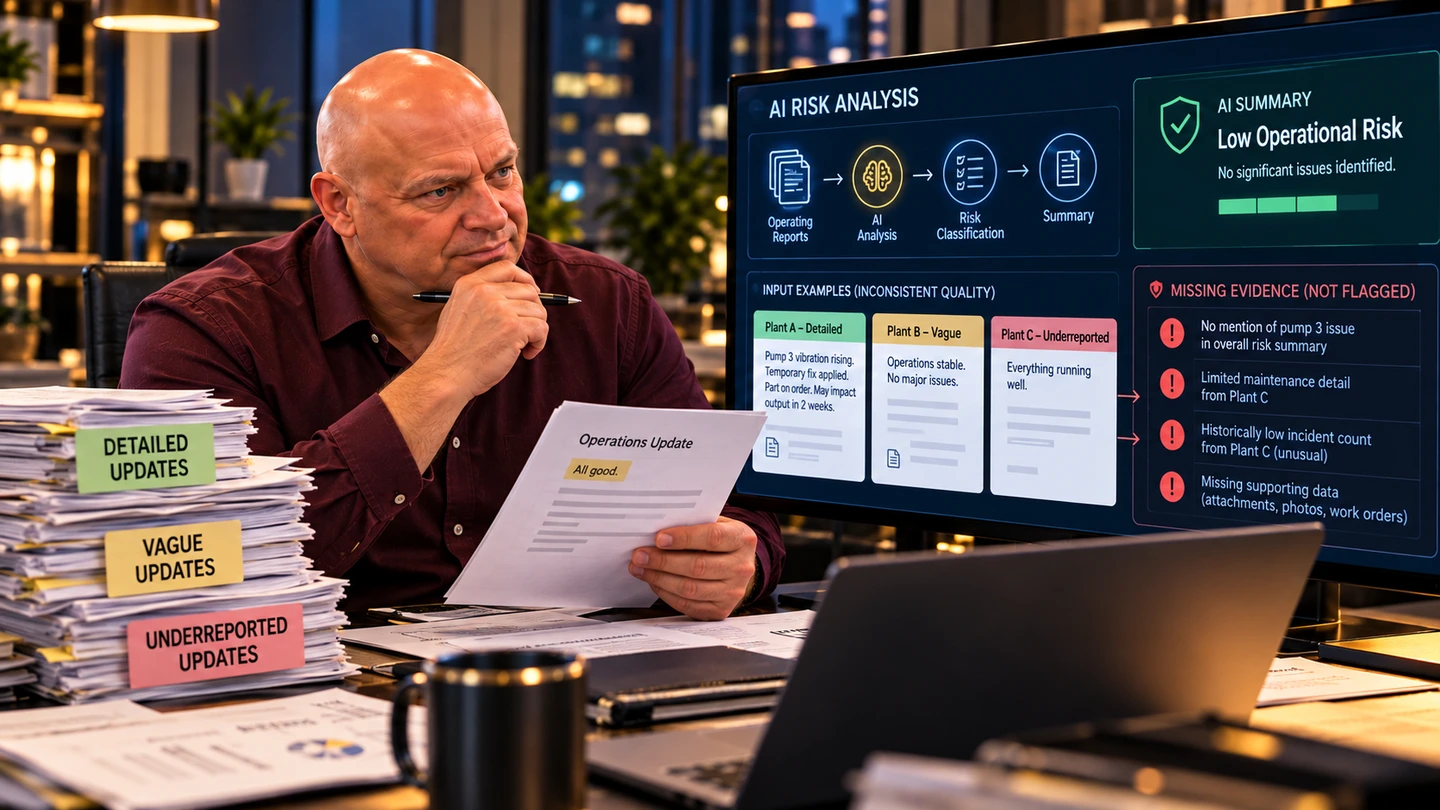
AI does not remove bad judgment. It can scale it. Many AI failures will come from the environment around the model: bad data, bad prompts, bad process, bad incentives, bad governance, and bad leadership assumptions.
The responsible AI conversation needs more business discipline. AI can be useful and risky at the same time. It can improve speed, communication, and decision support. It can also scale weak inputs, bias, privacy problems, overconfidence, and poor accountability.
The Real Issue
Bad financial data creates bad forecasts. Bad maintenance records create bad equipment decisions. Bad customer data creates bad sales strategy. AI is no different. If information going into the system is wrong, incomplete, biased, outdated, or poorly structured, the output may be weak.
People choose the tool. People define the use case. People provide the data. People write the prompts. People approve the workflow. People decide whether output is checked. People decide whether employees are trained. People decide whether governance exists. That means AI risk is also management risk.
Business Example
A company uses AI to identify operational risks from reports. But some managers document thoroughly, some write vague updates, and some underreport problems because they do not want attention. AI organizes the reports, but the input quality still controls the result.
The tool is part of the risk, but the bigger question is how the company uses it. AI can help businesses make better decisions, but it can also make weak decisions move faster. It can improve communication, but it can also create false confidence. It can reduce friction, but it can also hide accountability if leaders are careless.
What Leaders Must Watch
If people are rewarded only for speed, they may use AI without checking quality. If managers are rewarded only for cost reduction, they may automate work that still needs judgment. If executives are rewarded for appearing innovative, they may push AI before the company is ready.
Responsible AI requires clear use cases, approved tools, data rules, human review, training, transparency, measurement, risk assessment, and accountability. It also requires humility. AI can be useful and wrong, fast and incomplete, polished and misleading, helpful and risky. Leaders need to hold all of that at the same time.
Action Checklist
Before using AI in a business workflow, ask: What decision or output is being supported? What data is being used? Could the data be biased or outdated? Who reviews the result? Who owns the final decision? What happens if the output is wrong? Is the customer, employee, or company exposed to risk? What rule controls the workflow?
Closing Thought
The goal is not to fear AI. The goal is to lead it. AI should support better decisions, better communication, and better execution. It should not become an excuse for avoiding responsibility.
I help companies look beyond the tool and examine the operating incentives that determine whether AI improves work or scales bad habits.
Sources Consulted - NIST AI Risk Management Framework: https://www.nist.gov/itl/ai-risk-management-framework - NIST Generative AI Profile 2024: https://nvlpubs.nist.gov/nistpubs/ai/NIST.AI.600-1.pdf - IBM What is AI Governance: https://www.ibm.com/think/topics/ai-governance - OWASP Top 10 for LLM Applications: https://owasp.org/www-project-top-10-for-large-language-model-applications/ - OWASP LLM01 Prompt Injection: https://genai.owasp.org/llmrisk/llm01-prompt-injection/
← All insights