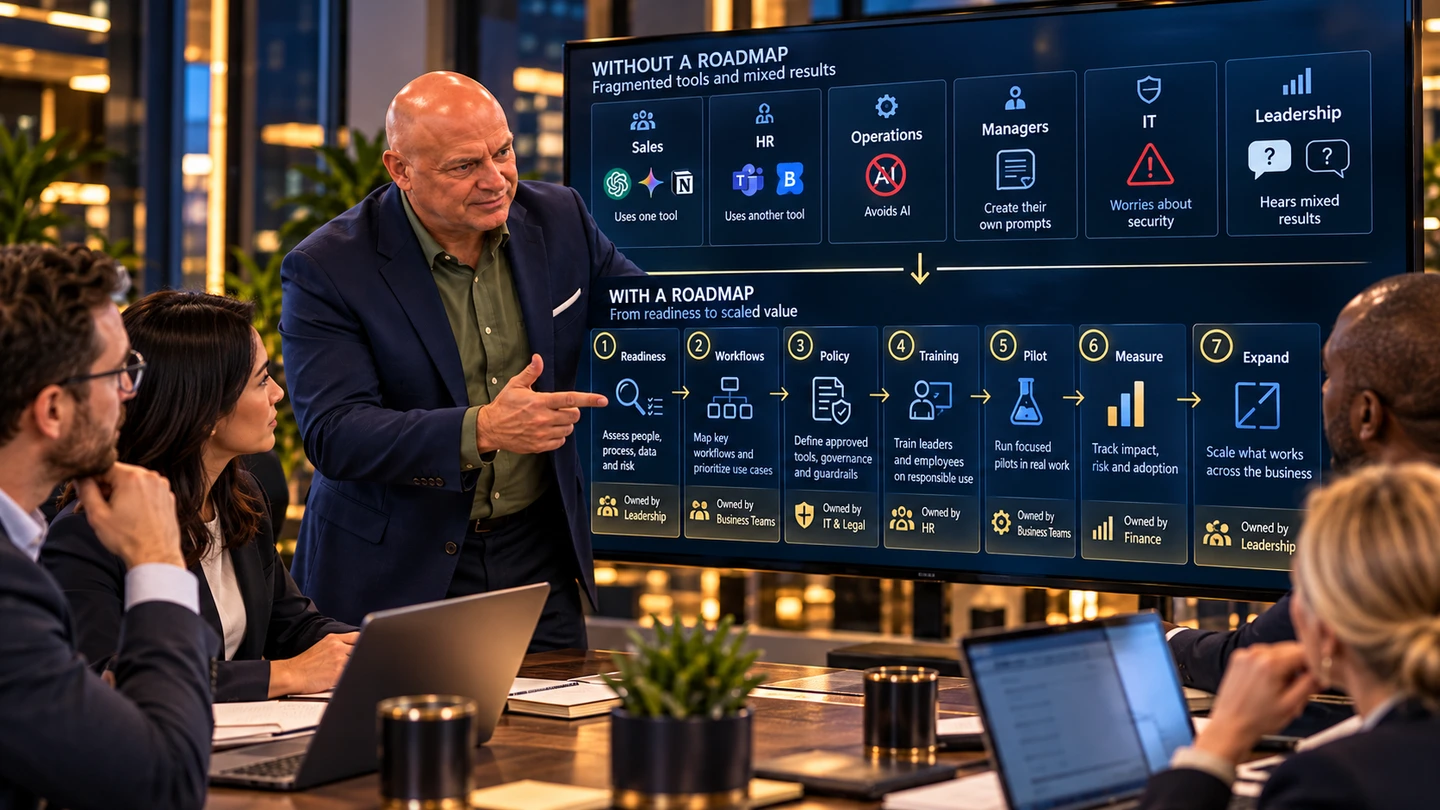
AI adoption is not a software purchase. It is an operating plan. A roadmap turns scattered AI activity into disciplined business execution.
AI readiness is not about chasing software. It is about preparing the business to use AI with purpose, discipline, and accountability. The companies that win with AI will connect the technology to real work, real people, real process, and real measurement.
Why This Matters
A practical AI roadmap connects tools, people, process, data, governance, training, risk, and measurement. It answers where the company is now, what problems it is solving first, what tools are approved, what risks must be controlled, and who owns the adoption path.
This is an executive operating issue. AI can help a company move faster, but speed only matters when the direction is right. If the business problem is unclear, AI becomes noise. If the workflow is unclear, AI can automate confusion. If the data is weak, AI can create polished but unreliable output. If people are not trained, AI can increase risk instead of reducing friction.
What I Would Look For
I would start by looking at where the work slows down, where decisions repeat, where documents are recreated, where people copy information from one place to another, and where knowledge is trapped in people's heads. Then I would separate three categories: work AI can safely assist, work AI can help prepare but a human must approve, and work AI should not touch until governance is stronger.
Business Example
Without a roadmap, sales uses one tool, HR another, operations avoids AI, managers create their own prompts, IT worries about security, and leadership hears mixed results. With a roadmap, the company assesses readiness, maps workflows, creates policy, trains leaders, runs pilots, measures results, and expands what works.
The lesson is simple: AI should support the work, not hide the problem. It should help employees organize information, communicate clearly, reduce repetitive effort, and improve execution. It should not become a substitute for leadership, judgment, or accountability.
Risk If Ignored
Without a roadmap, companies face tool sprawl, shadow AI, data exposure, employee confusion, weak measurement, wasted spending, and missed opportunities.
This is where many companies get AI wrong. They move too fast in the wrong places and too slowly in the places that matter. They buy tools before defining use cases. They experiment without rules. They measure activity instead of impact. That approach may look innovative, but it is not disciplined.
Action Checklist
Ask these questions before moving forward: What business problem are we solving? Who owns the workflow? What information is being used? What human review is required? What risk could be created? How will employees be trained? How will success be measured? Who is accountable if the output is wrong?
Closing Thought
AI should make businesses clearer, faster, and more disciplined. It should help people turn knowledge into action. But that only happens when companies treat AI adoption as an operating capability, not a technology trend.
If your organization has AI tools but no AI operating plan, this is the moment to build a roadmap before scattered activity becomes long-term confusion.
Sources Consulted - Microsoft 2026 Work Trend Index: https://blogs.microsoft.com/blog/2026/05/05/how-frontier-firms-are-rebuilding-the-operating-model-for-the-age-of-ai/ - Microsoft WorkLab - Agents and human agency: https://www.microsoft.com/en-us/worklab/work-trend-index/agents-human-agency-and-the-opportunity-for-every-organization - McKinsey State of AI 2025: https://www.mckinsey.com/capabilities/quantumblack/our-insights/the-state-of-ai - NIST AI Risk Management Framework: https://www.nist.gov/itl/ai-risk-management-framework - IBM What is AI Governance: https://www.ibm.com/think/topics/ai-governance
← All insights