AI may become one of the most important business tools ever created for people who think differently. Not because AI makes people smarter. Not because AI replaces human judgment. Not because AI magically solves learning differences, communication challenges, or the hard work of building something real. AI matters because it can reduce the friction between a strong idea and a usable output.
For many people, that friction is invisible. They think in a straight line, read quickly, write quickly, organize thoughts in sequence, and turn a blank page into a structured memo without much resistance. But not everyone thinks that way. Some people think visually. Some think in patterns. Some see the whole system before they can explain the first step. Some connect ideas quickly but struggle to put them into traditional written form. Some can diagnose a business problem in minutes, but turning that insight into a polished document takes much longer than it should.
That does not mean the thinking is weak. Sometimes it means the operating system is different. And this is where AI becomes powerful.
What Dyslexia Is - And What It Is Not
Dyslexia is commonly understood as a learning difference that can affect reading, spelling, word recognition, language processing, and sometimes the speed or sequence of written communication. It is not laziness. It is not low intelligence. It is not a lack of discipline. It is not a lack of ideas. It is not an inability to lead, build, sell, operate, innovate, or solve complex problems.
Dyslexia affects people differently. Some struggle mainly with reading speed. Some struggle with spelling. Some struggle with sequencing written information. Some struggle with working memory when processing a lot of text. Some compensate so well that others never see the effort behind the output. That last part matters in business because many high-performing professionals have spent years building workarounds. They memorize. They visualize. They ask someone to review a document. They use templates. They rely on verbal explanation. They create mental maps instead of written outlines.
This Is Bigger Than Most People Realize
Reading, writing and documentation demands affect people differently. Workplace support should begin with the individual and the task: which steps create friction, what support helps, and how the person can check the final output.
In a business context, the practical question is how to help employees communicate and execute their work. Platform membership totals do not establish how many users have dyslexia. The focus should be useful support and individual needs.
That means this is not a small side conversation. It is a leadership conversation, a workforce conversation, and a business performance conversation. It means that in many companies, some of the people struggling with traditional reading, writing, documentation, or communication systems may also be people with strong pattern recognition, visual thinking, creativity, problem-solving ability, entrepreneurial instincts, and operational insight.
Business Has Often Rewarded the Wrong Surface Signals
In many companies, the person who writes the cleanest memo is assumed to have the clearest thinking. Sometimes that is true. But not always. Business culture has a long history of confusing communication format with intelligence. The person who presents information in a conventional structure is often seen as organized, competent, and strategic. The person who explains things in a nonlinear way may be seen as scattered, even when they are seeing more variables than everyone else in the room.
Some of the best operators, entrepreneurs, builders, and problem solvers do not begin with a perfect outline. They begin with a picture, a pattern, a risk, a customer pain point, a system failure, or a gap between what leadership believes is happening and what is actually happening on the floor. They see the operational bottleneck before the weekly report catches up. They see the customer frustration before it becomes a churn number. They see the risk before it becomes an incident.
AI as a Translation Layer
For people who think differently, AI can act as a translation layer between the mind and the business system. It can help turn raw thoughts into outlines, a messy voice note into a structured memo, scattered ideas into a project plan, and a complicated concept into plain English. It can help draft emails, proposals, SOPs, meeting notes, checklists, strategy documents, job descriptions, training material, and executive updates.
The goal is not to make a dyslexic thinker sound like everyone else. The goal is to help the thinker communicate with enough structure that the originality can be understood, evaluated, funded, implemented, and scaled. AI should not flatten different thinking. It should amplify it.
The Difference Between Output and Originality
There is a real danger in using AI poorly. If someone uses AI to replace their own judgment, the work becomes generic. If someone copies and pastes without thinking, the output may look polished but contain no real insight. If a company uses AI to automate without accountability, it can scale errors, bias, bad assumptions, and shallow thinking.
That is not the opportunity I am talking about. The real opportunity is human-led AI. The person still owns the idea. The person still owns the judgment. The person still owns the responsibility. AI helps with the conversion process. For a visual thinker, AI can help convert a mental model into a written plan. For an entrepreneur, AI can help convert a rough concept into a pitch structure. For an operations leader, AI can help convert field observations into a corrective action plan.
Why This Matters for Business
Companies say they want innovation, people who think outside the box, problem solvers, and employees who challenge assumptions. But then many companies build systems that reward only one style of communication: long emails, dense policies, complex forms, bureaucratic reports, meetings with no visual structure, and written processes that make sense to the person who wrote them but not to the people expected to use them.
In that environment, different thinkers can be misunderstood. AI can help close that gap, not by lowering standards, but by improving access to structure. Imagine a company where the mechanic, driver, dispatcher, warehouse lead, safety manager, sales rep, technician, field supervisor, or customer service employee can quickly turn what they know into usable business intelligence.
A Practical Example
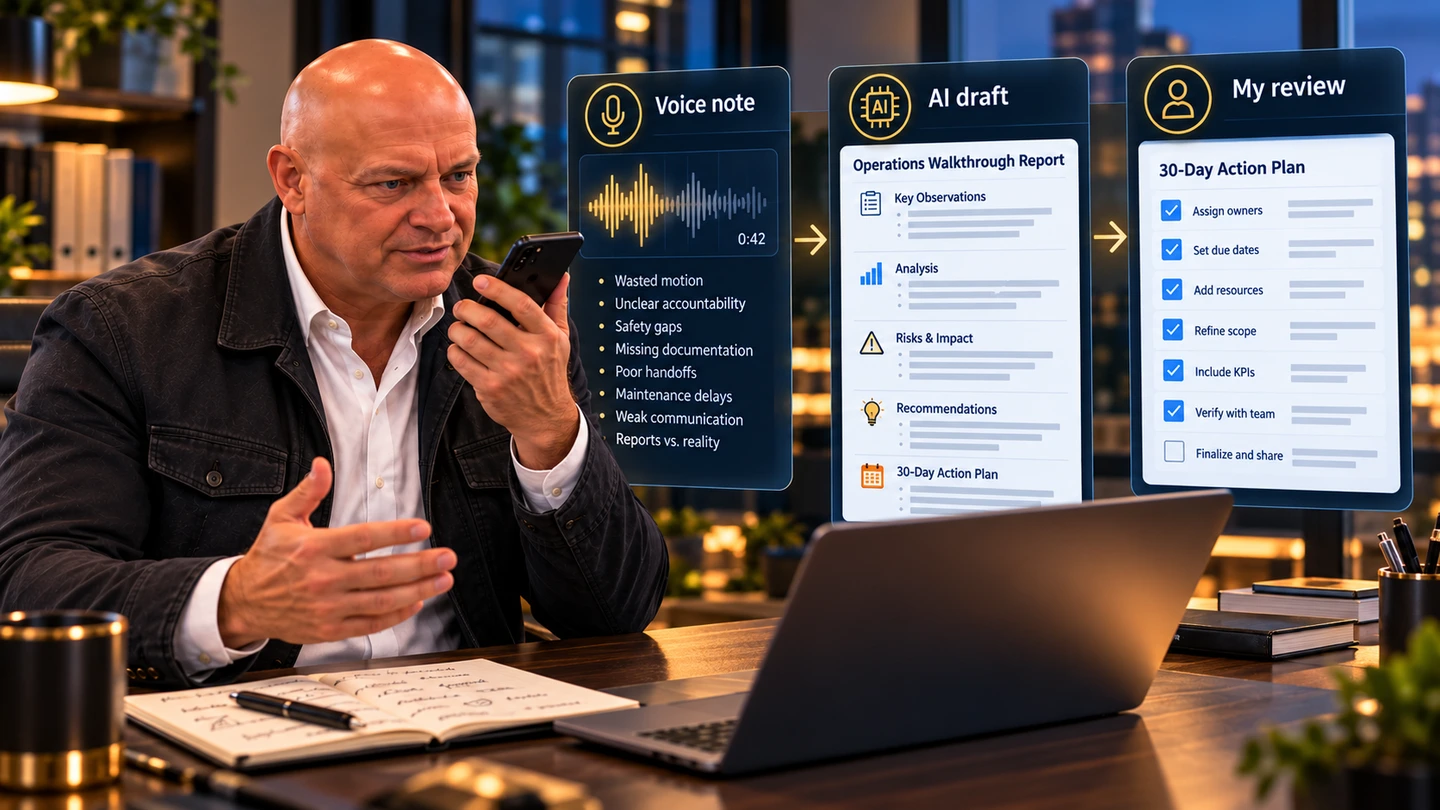
Imagine an operations leader who thinks in systems. He walks through a facility and sees problems immediately: wasted motion, unclear accountability, safety gaps, missing documentation, poor handoffs, maintenance delays, weak communication between departments, and a disconnect between leadership reports and operational reality. He can explain the problem verbally, but when asked to write a formal report, the process slows down.
Now add AI. He records a voice note after the walkthrough. AI turns it into a draft report. He asks AI to organize observations by safety, people, process, equipment, cost, customer impact, and corrective action. He asks AI to create a 30-day action plan. He reviews it, corrects it, adds judgment, removes anything inaccurate, and makes it his own. That is not artificial intelligence replacing an operator. It is operational intelligence becoming visible faster.
My View
I have always believed that strong execution starts with seeing the real system: the people, the process, the friction, the assets, the risk, the customer impact, the cost, the gaps, and the opportunities. Some people see that system in words. Some see it in numbers. Some see it in pictures. Some see it through motion, pattern, pressure, and experience. I tend to think in patterns, pictures, systems, and outcomes before words on a page.
That kind of thinking can be powerful in business, but it also needs structure to become useful to others. That is why I believe AI should be used to support better human performance - not to make everyone think the same, erase originality, replace judgment, or produce generic content with no accountability.
Closing Thought
The future of work should not be about forcing every person into the same communication model. It should be about building better systems around different kinds of intelligence. AI gives us a chance to do that. It gives dyslexic thinkers, visual thinkers, entrepreneurs, operators, builders, and unconventional problem solvers a new way to turn ideas into execution.
If your organization has strong ideas that never turn into action because they get stuck between insight and documentation, that is exactly the kind of business friction AI can help solve when it is used responsibly and with human judgment.
Sources Consulted - IDA Dyslexia Basics: https://dyslexiaida.org/dyslexia-basics/ - IDA Definition Project: https://dyslexiaida.org/2025-dyslexia-definition-project/ - Prevalence review - PMC: https://pmc.ncbi.nlm.nih.gov/articles/PMC8183124/ - LinkedIn About: https://about.linkedin.com/ - British Dyslexia Association - ChatGPT and dyslexia: https://www.bdadyslexia.org.uk/news/could-chatgpt-change-your-life - World Economic Forum - Neurodiversity at work: https://www.weforum.org/stories/2024/10/neurodiversity-neuroinclusion-workplace-business/ - Microsoft 2026 Work Trend Index: https://blogs.microsoft.com/blog/2026/05/05/how-frontier-firms-are-rebuilding-the-operating-model-for-the-age-of-ai/
← All insights